
📌 Quick Summary
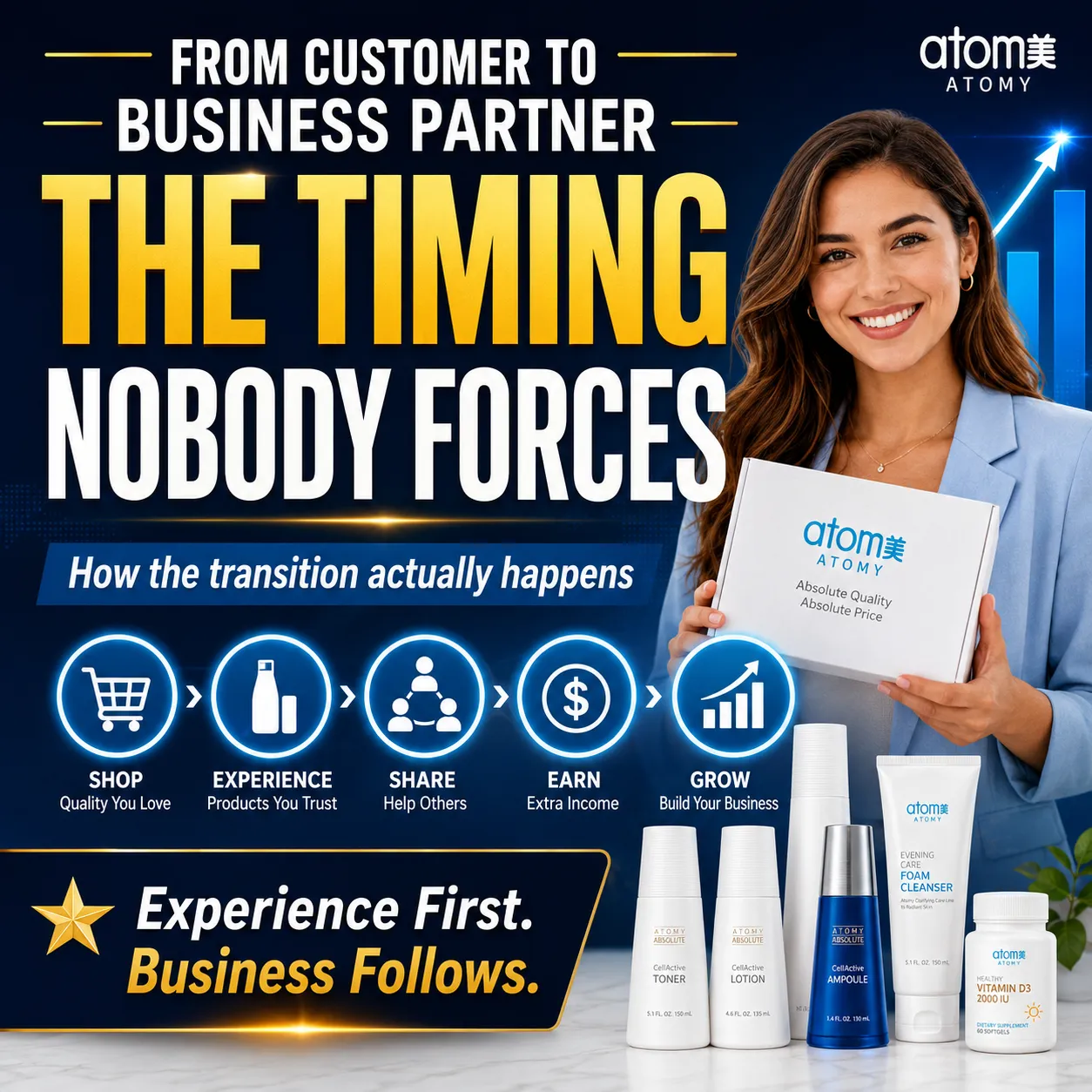
- In Atomy, consumer and business partner are not two separate identities you choose between at sign-up. There’s a five-stage transition path designed into the structure — from first purchase to active business partner — that unfolds naturally based on your own experience and timing.
- The shift happens when you’re genuinely satisfied with the products, you’ve naturally started recommending them, and commissions begin arriving on their own. Nobody has to push you across that line. The system is built so that real product experience leads there organically.
- Click the button below to go directly to the free sign-up page.
Nobody Told Me to Start a Business
When I first joined Atomy, I was just a customer. Someone I trusted mentioned a product, I signed up, ordered a few things, and that was the extent of it.
But something shifted over time — without any pressure from anyone. I swapped out my toothpaste for Atomy’s. Then my supplements. I started mentioning products in conversations with friends the same way I’d recommend a good restaurant. Then one Tuesday, I noticed a commission deposit in my account. I hadn’t done anything deliberately. The system had just been running in the background.
That was the moment I crossed from consumer to business partner — not because someone told me to, but because the structure had quietly guided me there through my own experience.
This post walks through Atomy’s five-stage transition model: what happens at each stage, what the signals look like, and why building through genuine product experience produces something more durable than recruiting-first approaches.
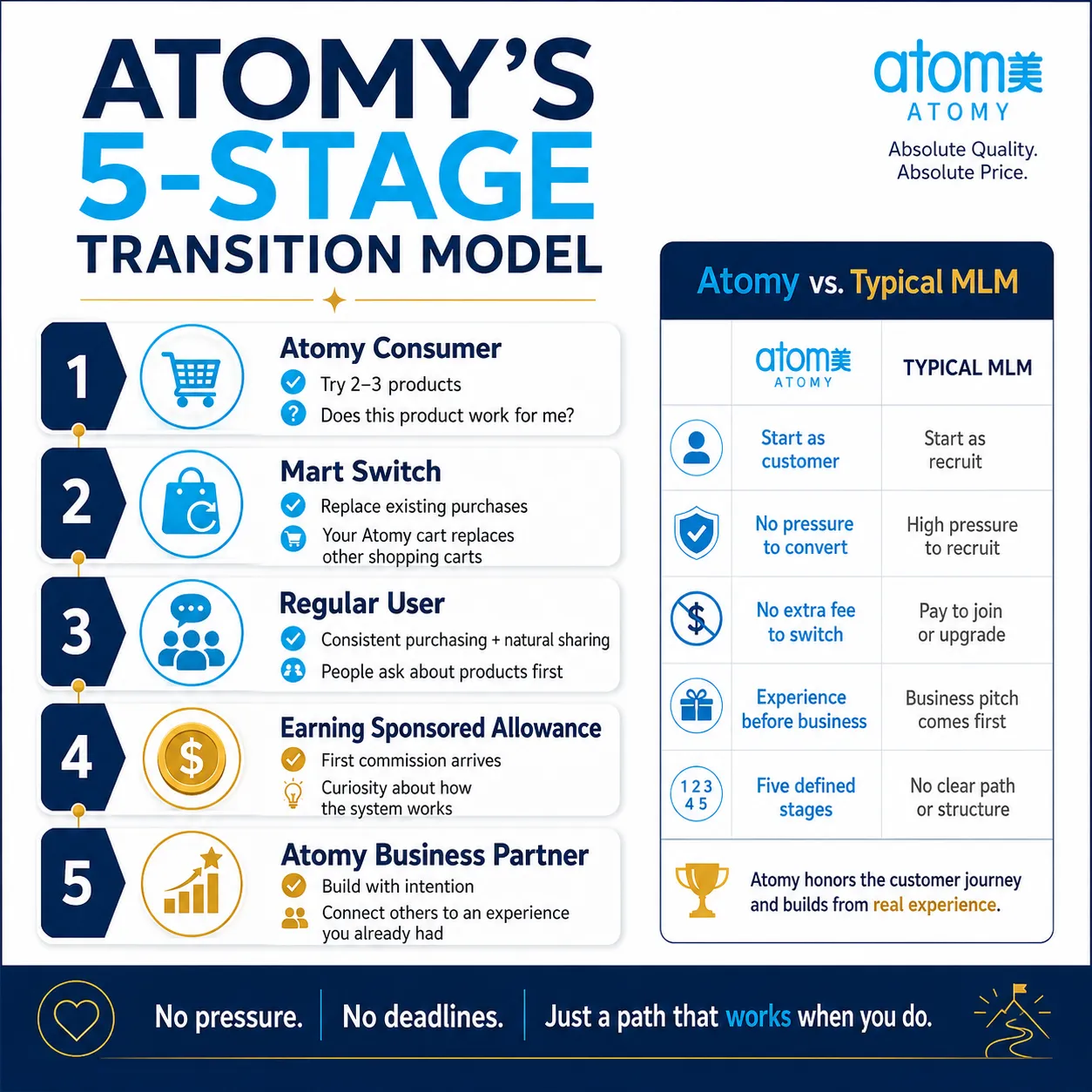
Atomy’s Transition Model vs. Typical MLM Sign-Up Structures
| Comparison | Atomy | Typical MLM |
|---|---|---|
| Must Decide “Business or Consumer” at Sign-Up | No — start as a customer | Often required at registration |
| When You Become a Business Partner | Whenever you choose — no deadline | Usually determined at sign-up |
| Cost to Switch from Consumer to Business | None | Sometimes requires additional fee |
| Pressure to Convert | None built into the structure | Monthly volume targets create implicit pressure |
| Starting Business Without Product Experience | Not structurally encouraged | Common — sign up and recruit immediately |
| Built-In Transition Path | ✅ Five defined stages | △ Usually absent |
| Auto-Consumer (middle stage) concept | ✅ Exists as a distinct phase | ❌ Not present |
※ Competitor characteristics reflect general MLM industry traits and vary by company.
Atomy’s foundational position is straightforward: you can’t genuinely share something you haven’t experienced. The five-stage path is designed so that product experience builds first — and business activity follows from that experience, not the other way around.
The Five-Stage Transition: What Actually Happens at Each Step
Stage 1 — Atomy Consumer: You Start Purchasing
Everything begins here. Whether you heard about Atomy from a friend, found it online, or were introduced by someone in your network — you sign up, you order something, and you try it. That’s Stage 1.
Nothing else matters at this point. Not commissions, not ranks, not the marketing plan. The only question that matters at Stage 1 is: does this product actually work for me? If the answer is yes, Stage 2 happens naturally. If the answer is no, nothing that follows matters anyway.
- The key action : Try 2–3 products in your first month
- The only question : Do I want to keep using this?
Stage 2 — Mart Switch: You Replace Existing Purchases with Atomy
Once you’re convinced a product is genuinely good, a natural behavior follows: you stop buying the equivalent elsewhere and buy it through Atomy instead.
You replace your toothpaste. Then your shampoo. Then your supplements. This is what Atomy calls “Mart Switch” — redirecting spending you were already doing into the Atomy store. It’s not additional spending. It’s a reallocation.
At this stage, PV accumulates automatically as a byproduct of shopping you were going to do anyway. No extra budget required. Your existing household spending starts building toward commission eligibility on its own.
- The key action : Swap one product category at a time over to Atomy
- The signal : Your Atomy cart is replacing other shopping carts — not adding to them
Stage 3 — Regular User: Consistent Purchasing + Natural Sharing
After using the products consistently for a while, something happens without you planning it. You mention them in conversation. Not a pitch — just the same way you’d tell someone about a show you’re watching or a restaurant you liked. “I’ve been using this and it’s been really good.”
That’s Stage 3. Regular purchasing and natural word-of-mouth happening simultaneously. People you mention products to join your organization. Your leg PV starts growing from organic activity rather than deliberate recruiting.
The authenticity here is what makes Stage 3 work. If the recommendation comes from genuine satisfaction, the person you introduce tends to have the same experience — and the cycle repeats without you managing it.
- The key action: Share your product experience the way you’d share any recommendation
- The signal: People start asking you about products before you bring them up
Stage 4 — Earning Sponsored Allowance: The First Commission Arrives
One Tuesday, a commission appears in your account. The amount doesn’t matter as much as what it means: the same purchasing you were already doing, the same conversations you were already having — and now there’s income attached.
“I didn’t do anything different. I just kept buying products I like and telling people about them.” That realization is what dissolves the perceived barrier between consumer and business partner.
This is also typically when people start seriously learning the marketing plan for the first time. Not because someone pressured them to study it upfront, but because experiencing the income creates genuine curiosity about how it works and how far it can go.
- The signal: First commission deposit
- The shift: Genuine interest in understanding the structure behind the income
Stage 5 — Atomy Business Partner: Building with Intention
The final stage is the decision to do this deliberately. You’ve experienced the products. You’ve seen the commission structure work. Now you want to build it with intention rather than letting it happen passively.
At Stage 5, the goal stops being “find people to sell to” and becomes “connect people to an experience I’ve already had.” The business isn’t built on persuasion — it’s built on repeating a cycle of genuine experience that you’ve already lived through. That’s why Atomy uses the term “business partner” rather than “distributor” or “salesperson.” The relationship is mutual, not transactional.
- The defining feature: Intentional organizational development, not passive accumulation
- The core: Connecting others to the same experience you’ve already had
3 Signals That Tell You the Transition Has Already Started
You don’t need to force the shift. If these three things are happening, the transition is already underway.
Signal 1: Reordering feels automatic When you started, it was “let me try this.” Now you notice when you’re running low and reorder before it runs out. This is Mart Switch completing itself — you’ve rebuilt a purchasing habit around Atomy without consciously deciding to.
Signal 2: People are asking you, not the other way around Someone in your life notices something — a product sitting on your counter, something you mentioned in passing — and asks you about it unprompted. That’s Stage 3 moving into Stage 4. The referral is happening without effort because the product experience is speaking for itself.
Signal 3: You’re curious about the structure, not just the amount Your first commission, you looked at the number. But at some point the question shifts from “how much did I get?” to “how does this actually work?” and “what would it look like if I built this intentionally?” That curiosity is Stage 5 beginning.
Why a Structure That Doesn’t Force the Transition Produces Stronger Organizations
Many network marketing companies pressure new members to start recruiting immediately — before they’ve had time to form any real product experience. The logic is short-term: faster activity, faster results.
The problem is that people who recruit before they believe in the product can’t transfer genuine conviction. The person they bring in inherits the same shallowness, and the organization built that way tends to collapse when the recruiting energy runs out.
Atomy’s five-stage model is slower to start — but each stage builds a layer of real experience. Stage 2 creates personal conviction. Stage 3 creates natural referrals. Stage 4 creates evidence that the system works. By the time someone reaches Stage 5 and starts building intentionally, they have all four layers underneath them.
Organizations built that way last. That’s the structural answer to why genuine consumer experience first produces more durable business outcomes.
How to Join Atomy in the US
No enrollment fee. No monthly charge. Start as a consumer, and move to active business partner on your own timeline.
Register at us.atomy.com with Sponsor ID 47459254 and your account is active immediately at member wholesale pricing.

Scan the QR code above to go directly to the global team sign-up page.
If you can’t scan the QR code, visit us.atomy.com, select the United States as your country, and enter Sponsor ID 47459254 in the sponsor field on the registration page.
Your sponsor assignment is permanent and cannot be changed after registration.
Frequently Asked Questions
Q1. Can I start as a business partner from day one instead of going through the consumer stages?
You can — there’s no rule preventing it. But Atomy’s design philosophy is that product experience comes first. People who recommend something they’ve personally used and believe in tend to build organizations that hold together over time. People who recruit before they have that conviction tend to build organizations that don’t. The five stages aren’t mandatory; they’re just what works.
Q2. Is there a cost or paperwork involved in switching from consumer to business partner?
No. In Atomy, there’s no formal distinction between “consumer member” and “business partner member” at the account level. Every member joins under the same conditions. Commission eligibility activates automatically once your downline organization meets the qualifying volume thresholds — no application, no upgrade fee, no separate registration required.
Q3. What exactly is an “Auto-Consumer” and where does it fit?
The Auto-Consumer is the middle stage between pure consumer and active business builder. It describes a member who purchases consistently, has shifted their household spending toward Atomy products, and shares recommendations naturally — but isn’t yet actively developing their organization with intention. It’s not an official rank. It’s the phase where most of an organization’s sustainable volume actually comes from — members who buy because they love the products, not because they’re chasing commission.
Q4. Do I have to pressure people to join in order to build a business?
No — and pressure typically backfires anyway. When you’re genuinely enthusiastic about a product you’ve been using, people notice. They ask questions. They come to you. The most effective referrals in Atomy come from people who weren’t looking for a business — they were just looking for a good product, heard about it naturally, and joined because the experience resonated. Share what you have. Don’t pitch what you don’t believe.
Q5. If I join with Sponsor ID 47459254, will I get support through the transition stages?
Yes. Joining with Sponsor ID 47459254 connects you to an active global powerline where people at every stage of the five-step transition are already operating. You’ll receive structured guidance on the marketing plan, practical support for the early product experience phases, and a network of partners who have already made the transition themselves — so the path from consumer to business partner has been walked before, and you won’t be navigating it alone.